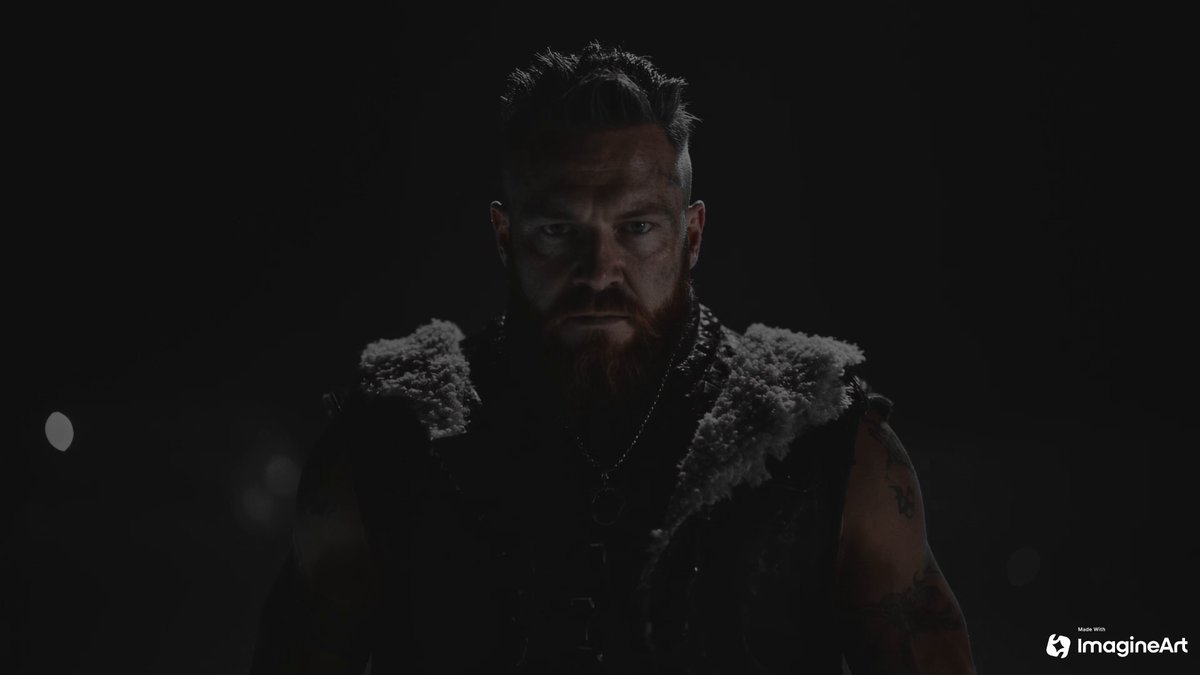
Muted preview loop · press play for the full film with sound
- Title
- Cone Man takes the mic
- Type
- Music-video remix
- Runtime
- 0:15.1
- Frame
- 1536 × 2688 · 30 fps
- Generation
- MiniMax Hailuo H3 Max
- Finish
- Topaz Upscale
Same character. A different stage.
Cone Man steps up to the microphone while the backup dancers carry orange traffic cones. The remix moves between the performance and bar scene, then returns to Cone Man singing.
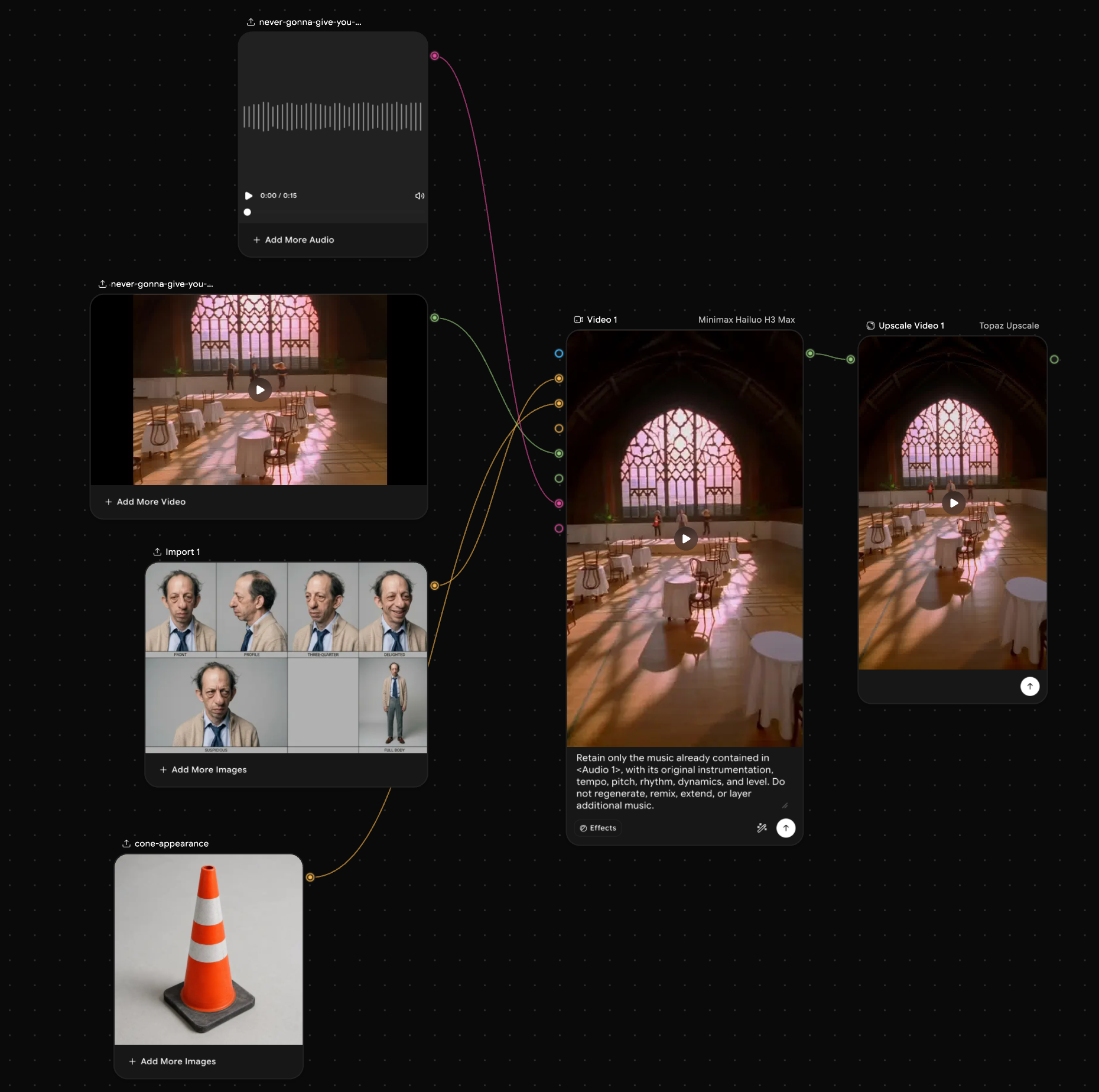
The flow combines source footage and audio with separate references for Cone Man’s identity and the cone’s appearance.
From references to the remix.
Result + 45-second tutorial ready.
Watch the walkthrough
Four inputs. One connected flow.
A 45-second breakdown of the four-input setup, Hailuo H3 Max, the prompt’s target and cone rules, the result review, and Topaz Upscale.
The walkthrough shows the difference between the requested one-cone edit and what the model produced, so the review step stays part of the process.
- 4 inputs
- MiniMax Hailuo H3 Max
- Topaz Upscale
Get the exact prompt ↓Open this workflow ↗
Local preview encode (480 × 854) for this review. Open the original tutorial file ↗ · Result & tutorial page ↗
How this was made · the setup comes from the actual workflow used for this revised result
F01Character + prop
Keep the references separate
The Cone Man sheet defines the performer’s identity. A second image, labeled “cone-appearance,” defines the orange-and-white traffic cone used in the remix.
F02Source video + audio
Bring in the performance
The source video and its audio are separate connected inputs. The visible audio instruction asks the generation to retain the supplied music, without adding or regenerating it.
F03ImagineArt / MiniMax Hailuo H3 Max
Generate the remix
The two reference images, source video, and audio feed into the Hailuo H3 Max video node. Review the generated faces, cone placement, movement, and transitions against the intended edit.
F04ImagineArt / Topaz Upscale
Finish with an upscale
The generated video feeds into Topaz Upscale. The finished portrait output shown here is 1536 × 2688, with the added cone props visible in the performance.
Inside ImagineArt
The actual setup.
- Input 1Cone Man identity sheet
- Input 2Traffic-cone appearance image
- Input 3Source video
- Input 4Source audio
The exact video-edit prompt
Inside the revised edit
The prompt asks for one cone with one dancer and 16:9 framing. The finished result above is portrait and shows two cones in the dance scene; these instructions are the intended edit.
subject_definitions:
<Subject 1> is Cone Man, shown in image1. He replaces ONLY Rick Astley, the lead singer originally wearing the dark blue jacket in <Video 1>. Image1 defines Cone Man’s facial identity, hair, skin tone, facial structure, body proportions, complete clothing, and visible accessories. Transfer the original singer’s exact performance to Cone Man. Do not copy image1’s background, static pose, reference-sheet layout, or labels.
<Subject 2> is the single traffic cone shown in image2. Image2 defines its shape, proportions, colors, materials, markings, and base. Exactly ONE cone exists in the target video. One original female background dancer carries it.
<Video 1> is the supplied never-gonna-give-you-up-15s.mp4. It is the direct editing source and controls the complete 15.00-second shot sequence, camera framing, singer choreography, environments, lighting, microphone, and background activity. Only the blue-jacketed lead singer is replaced. The original dancers retain their identities and outfits; only the designated cone-carrying dancer’s hand and arm movements adapt to support <Subject 2>.
<Audio 1> is the supplied matching 15.00-second WAV or MP3. It is the complete final soundtrack and the authority for singing, musical timing, rhythm, phrasing, and synchronization. Use one audio file only.

summary:
[video editing + reference generation + audio reuse] The target video is an edited version of <Video 1>. Replace ONLY the lead singer originally wearing the dark blue jacket with <Subject 1>, retaining Cone Man’s complete image1 appearance and reproducing the singer’s exact performance. Add the single <Subject 2> as a prop carried by one original female background dancer. She dances with it while preserving her source footwork, positions, and timing. The other dancer remains empty-handed. Preserve every other person’s original identity and wardrobe, the source cuts, and the complete 15.00-second timeline. Use <Audio 1> unchanged.

retention_analysis:
<Subject 1>: fully_preserved — retain Cone Man’s image1 identity, natural proportions, complete wardrobe, and accessories throughout.
<Subject 2>: fully_preserved — retain the single image2 cone’s appearance and proportions, consistently assigned to the same dancer.
<Video 1>: partially_preserved — replace only the blue-jacketed singer’s appearance and wardrobe; add one cone and adapt its designated dancer’s hand and arm movements. Preserve the singer’s performance, all other identities and wardrobe, environments, camera behavior, cuts, and timing.
<Audio 1>: fully_copy — use the complete supplied audio unchanged as the entire final soundtrack.

detailed_description:
Preserve the live-action music-video appearance of <Video 1>, including its image texture, original colors, lighting, 16:9 framing, and camera behavior. Integrate the single cone physically into the dancer scenes with matching illumination, shadows, perspective, motion blur, and occlusion. The source frames remain the authority for the performance and editing.

GLOBAL REPLACEMENT TARGET LOCK:
The ONLY replacement target is Rick Astley, identified in the original source by his dark blue jacket and lead-singer role at the microphone. Track this same individual through every shot, close-up, turn, partial crop, and occlusion, including frames where his jacket is outside the crop.

Replace his appearance and wardrobe with <Subject 1> from image1. The dark blue jacket identifies the source person to replace; Cone Man’s target clothing comes entirely from image1.

Do not transfer Cone Man’s face, hair, body, clothing, or accessories to the bartender, either female dancer, or any background person. Preserve every non-target person’s original identity, wardrobe, and anatomy. Do not select another person for replacement because they wear a similar color.

GLOBAL SINGER PERFORMANCE LOCK:
Whenever the original singer is visible, Cone Man occupies his corresponding location and reproduces his exact gaze, head angle, changing expressions, shoulder movement, torso sway, weight shifts, footwork, arm trajectories, wrist rotations, hand shapes, and gesture timing. Preserve which hand performs each action. Do not mirror, exaggerate, delay, simplify, or improvise the performance.

Match Cone Man’s mouth movements to the original recorded singing, including syllable timing, held notes, closures, and breaths. The vocal remains part of <Audio 1>; generate no independent voice.

Cone Man does not carry, touch, point at, or react to the cone. His choreography remains identical to the original singer’s performance. Keep his face, mouth, microphone, and gestures unobstructed.

GLOBAL SINGLE-CONE LOCK:
Exactly ONE physical <Subject 2> exists in the entire video. Assign it to the original female dancer visible in the first window-side dance shot. Maintain that same dancer-to-cone assignment whenever she reappears.

The other female dancer remains empty-handed and follows her original choreography. Do not duplicate the cone for her, add cones to the set, or introduce a handoff. When the designated dancer leaves the frame, the cone leaves with her.

GLOBAL CONE CHOREOGRAPHY:
The designated dancer preserves her original steps, turns, travel path, spacing, and rhythmic timing. Adjust only the hand and arm movements needed to carry <Subject 2> securely, supporting its base or gripping its body according to its visible construction.

During source arm extensions, she presents the cone outward at waist-to-chest height. During inward gestures, she draws it toward her torso. During turns, the cone follows her body rotation and momentum as one rigid object. Use small rhythmic lifts and side-to-side swings synchronized to the source music.

Maintain visible hand contact, believable weight, consistent dimensions, and the exact image2 appearance. The cone never floats, deforms, multiplies, passes through a body, or jumps between hands across cuts. Do not change the camera or the singer’s performance to showcase it.

[Shot 1]
Begin with the source’s wide interior composition, tables, chairs, and large decorative window. Replace only the distant blue-jacketed lead singer with <Subject 1>, matching his original location and movements. If the designated female dancer is visible, she carries the single <Subject 2> while following her source dance timing. Preserve every other person and all background activity. Do not introduce anyone into an empty area.

[Shot 2] At 00:01.200, the camera cuts to the source’s close view of the singer beside the microphone.
Replace only that same lead singer with <Subject 1>. Match his head turn, gaze, expression, and singing articulation frame by frame. Preserve the microphone, patterned background, lighting, and crop. Do not insert the cone into this close-up.

[Shot 3] At 00:01.840, the camera cuts to the source’s medium performance view.
Cone Man reproduces the original singer’s raised-hand gesture, subsequent hand movements, rhythmic sway, and changing head angles in their original order. Preserve the exact hand used, gesture height, and relationship to the microphone. His hands remain free of cone props.

[Shot 4] At 00:04.120, the camera cuts to the source’s tighter face view.
Replace only the singer’s appearance with Cone Man’s. Match the original close-up performance, preserving Cone Man’s recognizable identity during every mouth shape and head movement. Maintain the source framing and uninterrupted soundtrack.

[Shot 5] At 00:05.560, the camera cuts to the wider window-side performance with the background dancer.
Cone Man follows the original singer’s exact gestures, stance changes, body sway, and microphone interaction.

The original female dancer carries the single <Subject 2>. She moves it gently outward and inward with her source arm rhythm while maintaining her original steps and position. Preserve her original face, hair, black outfit, and proportions. Keep the cone attached to her handling through turns, occlusions, and partial exits from the frame. No second cone appears.

[Shot 6] At 00:08.680, the camera cuts to the bartender behind the bar.
Preserve this entire shot unchanged. The bartender in the white shirt and red suspenders is NOT the replacement target. Retain his original identity, wardrobe, movements, counter interaction, and timing. Add neither Cone Man nor a traffic cone to this shot.

[Shot 7] At 00:11.120, the camera cuts to the wider singer-and-dancers composition.
Replace ONLY the lead singer originally wearing the dark blue jacket with Cone Man. Match his exact stance, arm movements, singing, and rhythmic performance.

The designated female dancer continues carrying the same single <Subject 2>, using small lifts, outward presentations, and side-to-side swings that fit her source dance rhythm. The other female dancer remains empty-handed and performs her original choreography. Preserve both dancers’ identities, outfits, footwork, travel paths, and spacing. Keep the cone clear of Cone Man and the microphone.

[Shot 8] At 00:13.080, the camera cuts back to the bartender.
Preserve this entire shot unchanged, including his original identity, white shirt, red suspenders, glass-and-cloth handling, action timing, and camera framing. Cone Man and the cone do not appear.

[Shot 9] At 00:14.600, the camera cuts to the final medium view of the singer.
Cone Man matches the original singer’s corresponding gestures, expression, mouth movements, and pose through 15.00 seconds. Preserve the original crop. The single cone appears only if its designated dancer is naturally visible within that crop. Do not bring it into the foreground.

End at 15.00 seconds on the corresponding source frame, with no fade, extension, or invented finishing gesture.

FINAL LOCKS:
ONLY REPLACEMENT TARGET = the original lead singer wearing the dark blue jacket.
ONLY CHARACTER REPLACEMENT = Cone Man from image1.
ALL OTHER PEOPLE = retain their original identities and wardrobe.
SINGER PERFORMANCE = reproduce the source exactly.
CONE COUNT = exactly ONE, matching image2.
CONE CARRIER = the same designated original female dancer throughout.
OTHER DANCER = empty-handed, original choreography.
BARTENDER SHOTS = completely unchanged.
Use the actual cuts in <Video 1> as the final timing authority.
Add no extra cones, handoffs, people, subtitles, lettering, new shots, fade, or extension.

overall_soundscape:
Use <Audio 1> unchanged as the complete final soundtrack, preserving its existing mix and embedded sounds. Add no cone-handling sounds, ambience, dialogue, effects, or replacement vocals. If direct audio copying is unsupported, preserve exact visual synchronization and attach the supplied audio unchanged during final assembly.

non_diegetic_music:
Retain only the music already contained in <Audio 1>, preserving its original speed, pitch, instrumentation, rhythm, dynamics, and level. Do not regenerate, remix, extend, or layer additional music.
Tools I use for this
Build your own reference-driven remix.
ImagineArt brings the inputs, Hailuo H3 Max generation, and Topaz upscale into the connected workflow shown above. Start with your own footage and reference images, then inspect the result before upscaling.
Referral link. I may earn a commission if you purchase through it. Disclosure